Dashavatara
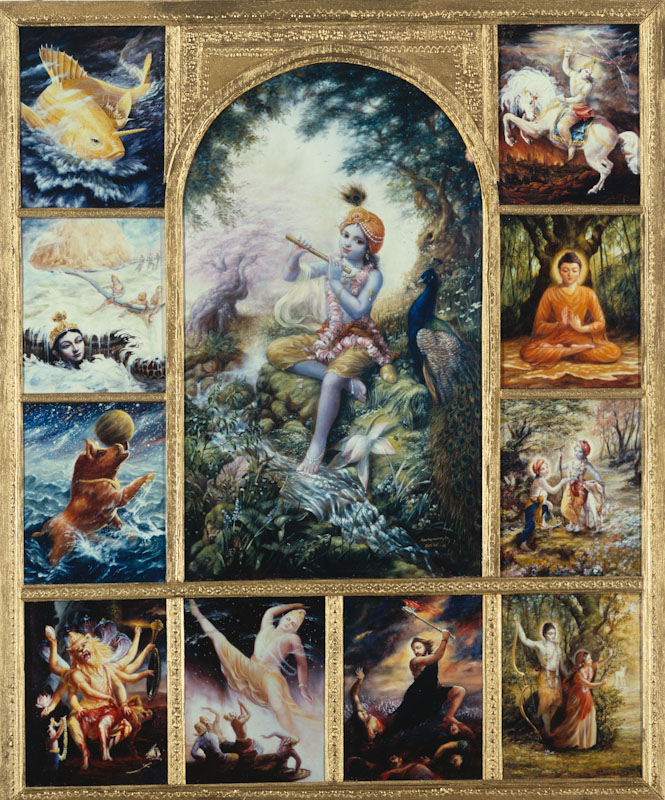
A fish, a turtle, a boar, a man-lion, a dwarf, a warrior, a prince, a charioteer, a teacher, and a blazing comet.

Here at Bhaktiville on Secondlife, Dasi Lane is busy preparing for the Dashavatara pilgrimage, which is a spiritual journey visiting temples dedicated to the ten primary incarnations (Dashavatara) of Lord Krishna. An auspicious time for this is during Kartik, which starts October 25th. The weather is cooler, and tours can take between a weekend or 10 days. In India there are various pilgrimage circuits with some spanning multiple states, covering roughly 7,000 kilometres!
Dasi is building 10 dedicated temples and will create a pilgrimage course on the land at Bhaktiville in the spirit of the physical pilgrimage. An intense 10-day schedule of commercial flights and 4WD vehicles will not be nessesary!
The Bhaktiville Dashavatara pilgrimage will focus on the glorious pastimes of Lord Krishna in our world, but also upon pilgrimage as an internal, esoteric meditation mirroring the the evolutionary stages of consciousness that a devotee may experience in spiritual progress. These two parallel paths of pilgrimage — both internal and external — are essential for the bhaktas following this path of devotion. Here is a summary of the avatars.
- Animal avatars (Matsya, Kurma, Varah) – mastering lower, instinctive, and biological natures.
- Half-human avatars (Narashimha, Vamana, Parashurama) – the transition, eclipsing the animalistic ego and overcoming primal fears.
- Human avatars (Rama, Krishna / Balarama, Buddha) – attaining Divine love and liberation.
- Unmanifested potential (Kalki) – the final, radical transformation of consciousness. The white horse representing the purified mind and the flaming sword representing the ‘spiritual discrimination’ of cutting through the final knot of ego and illlusion binding us to material existence.
The “outer temple” pilgrimage, in this temporary physical world, is used as a visual metaphor to build a permanent “inner temple” within the heart, an inner temple where Lord Krishna lives.
Philosophical anchors in the Bhagavad Gita
A pilgrimage is more about navigating the landscape of your consciousness, rather than moving through a spiritual space. The holy ground of the pilgrimage is the physical vessel – “This body, O son of Kunti, is termed the field (Kshetra)…” (BG.13.2) – the body is only the Kshetra (the holy site, field, or temple). The true pilgrim is the Kshetra-jña (the knower of the field) who is purifying the “field” of ignorance and awakening to the original divine consciousness.
This evolutionary journey from senses to soul is mirrored in the verse “The senses are superior to dull matter; mind is higher than the senses; intellect is still higher than the mind; and the soul is even higher than the intellect.” (BG.3.42)
A verse echoing the Kalki avatar’s appearance refers to controlling the ‘white horse’ of the mind . The mind being transformed from a turbulant battlefield (Kali Yuga) into a tranquil sanctuary (Satya Yuga) “Elevate yourself by your own mind, do not degrade yourself. For the disciplined mind is the best of friends, but the untrained mind is the greatest enemy.” (BG.6.5-6)
When we are travelling thousands of miles to find a deity in a temple, isn’t it like the chariot within our heart being lead to transcend the false ego?
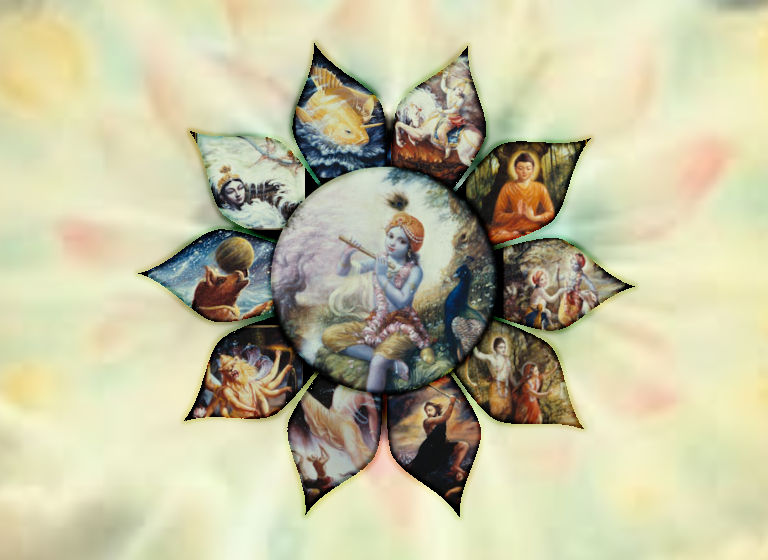
The Ten Complete Avatar Incarnations
दशावतार (daśāvatāra)
The word Dashavatara derives from daśa, meaning “ten,” and avatāra, roughly equivalent to “incarnation.”
The Dashavatara are the ten primary incarnations of Lord Krishna who descend to restore dharma (cosmic order) and protect the righteous.
| Name | Form | Significance |
| Matsya | fish | aquatic invertebrate |
| Kurma | tortoise | amphibious |
| Varaha | boar | terrestrial vertebrate |
| Narasimha | man-lion | intermediate humanoid |
| Vamana | growing dwarf | developing hominid |
| Parashurama | early man | primitive, barbaric |
| Rama | ideal hero | advanced, civilised |
| Krishna / Balarama | teacher, Supreme Divinity | wise, loving relationships |
| Buddha | enlightened ascetic | ultra-wise, intellect and compassion |
| Kalki | saviour, advent | destructive, reset, cosmic destiny |
Bhaktivinoda Thakura introduced the concept that the Dashavataras, when organized in a certain order, represent a gradual evolution of consciousness and physical form, moving from aquatic life to fully realized divinity, which highlights soul-transmigration.
In contrast to Darwin’s theory of species evolution, this is a Vaisnava perspective that emphasises the transmigration of conditioned souls (jivas) moving through various levels of consciousness during the repeating cycle of birth and death (saamsara). Bhaktisiddhanta Sarasvati Thakura adds that these ten manifestated incarnations of Krishna are worshipable Deities with eternal transcendental Names, Forms, Attributes and Pastimes.
The fountainhead of all avatāras
In order to deliver the pious and to annihilate the miscreants, as well as to reestablish the principles of religion, I advent Myself millennium after millennium. – (Bhagavada-gita As It Is 4.8)
Srila Prabupada explains that in this verse, “that to deliver the devotee and vanquish the demon miscreants, the Lord appears in different incarnations” and that “Lord Kṛṣṇa is the primeval Lord, the fountainhead of all avatāras“. He also specifically includes a verse from Caitanya-caritāmṛta summarizing these principles of incarnation: “the particular form of the Personality of Godhead who so descends is called an incarnation, or avatāra. Such incarnations are situated in the spiritual world, the kingdom of God. When they descend to the material creation, they assume the name avatāra.“
From Srila Bhaktivinoda himself
You can read here an English translation, from Srila Bhaktivinoda’s book “Krsna Samhita,” about dashavatara. (See here for full text: https://bhaktivinodainstitute.org/sri-krsna-samhita-chapter-3-descriptions-of-the-lords-incarnations/)
TEXT 5
When the conditioned souls receive various forms according to their nature, the Supreme Lord Kṛṣṇa, by His inconceivable potency, agrees to accompany them by incarnating and enjoying pastimes with them.
TEXT 6
When the living entities accept the position of fish, the Lord accepts His fish incarnation, Matsya. Matsya is without daṇḍa [spine]. When the living entities gradually accept the position of vajra-daṇḍa, then the Lord incarnates as Kūrma. When vajra-daṇḍa gradually becomes meru-daṇḍa, the Lord incarnates as Varāha.
vaj ra dan-da gradually becomes meru dan-da, the Lord incarnates as Varaha.
TEXT 7
When the living entities accept the combined position of human and animal, the Lord accepts His incarnation of Nṛsiṁha. When the living entities are short, He appears as Vāmana. When the living entities are uncivilised, He comes as Paraśurāma. When they are civilized, He appears as Rāmacandra.
TEXT 8
When the living entities possess the wealth of practical knowledge, then Lord Kṛṣṇa Himself appears. When the living entities develop the tendency for argument, the Lord appears as Buddha. And when they are atheistic, the Lord comes as Kalki. These are well-known facts.
TEXT 9
In the course of the gradual development of the living entities’ hearts, the Lord incarnates in a form corresponding to the mood of the devotees. The source and activities of those forms are untouched by material contamination.
References
https://iskconeducation.org/media_library_old/Das20Avatar20-20WB.pdf
https://www.iskconbangalore.org/blog/supreme-lord-incarnations/


Leave a Reply